

Intuitive Eating offers a revolutionary, holistic pathway to health and well-being, gently guiding individuals away from rigid external food controls like diet rules, calorie counting, and strict portioning. Instead, it fosters a profound reconnection with your body’s innate wisdom – listening to authentic hunger and fullness cues, recognizing true satisfaction, and discerning what genuinely feels good for *you*. This approach thoughtfully integrates gentle nutrition, ensuring your body receives the nourishment it needs without the burden of judgment or restriction. In this comprehensive guide, we’ll explore the core tenets of intuitive eating, identify who stands to benefit most, and dismantle pervasive myths surrounding this transformative philosophy.
While the term “intuitive eating” has surged in popularity across social media platforms over recent years, becoming a trending hashtag, its origins trace back much further than many realize. The foundational framework for Intuitive Eating was meticulously developed in 1995 by two visionary Registered Dietitians, Elyse Resch and Evelyn Tribole. Their pioneering work laid the groundwork for what has since become an evidence-based approach to fostering a healthy relationship with food and body.
It’s incredibly encouraging to witness the growing dialogue around intuitive eating, reflecting a collective desire for a more compassionate and sustainable approach to health. However, this widespread interest has also inadvertently led to a proliferation of misinformation and misunderstandings about the topic. To provide clarity and depth, guest author and intuitive eating dietitian, Ally Choo, delves into the precise definition of intuitive eating, meticulously outlining its 10 guiding principles, and identifying individuals who can truly thrive by embracing this practice. Furthermore, she tackles some of the most persistent myths head-on, offering serious myth-busting insights that illuminate the true essence of intuitive eating.
Let’s embark on this journey of understanding and self-discovery.
- What is Intuitive Eating?
- What are the 10 Principles of Intuitive Eating?
Intuitive eating is a robust, evidence-based, self-care eating framework. It was meticulously developed by the trailblazing Registered Dietitians Evelyn Tribole and Elyse Resch, offering a profound alternative to the conventional diet mentality. For a deeper exploration, you can read more about its core principles and philosophy here.
The founders of intuitive eating established 10 transformative guiding principles designed to mend and heal your relationship with food and your body. These principles are comprehensive, addressing various facets of eating, from the crucial step of rejecting the pervasive diet mentality, to the vital process of reconnecting with your body’s intrinsic hunger and fullness signals, embracing joyful movement, and much more. You can delve into each of these 10 principles here.
What is Intuitive Eating? A Deep Dive
Intuitive Eating is far more than just a set of dietary guidelines; it is a comprehensive, evidence-based, and compassionate self-care eating framework built upon 10 core principles. Conceived by Registered Dietitians Evelyn Tribole and Elyse Resch, this framework is fundamentally rooted in the philosophy of weight neutrality. This means that its primary focus is not on weight loss or achieving a particular body size, but rather on promoting health-affirming behaviors, fostering a positive body image, and cultivating a genuinely healthier and more peaceful relationship with food, irrespective of an individual’s weight or shape.
Through the practical application of these 10 principles, intuitive eating empowers individuals to effectively meet both their physical and psychological needs. This is achieved by encouraging a deep internal focus, prompting you to reflect deeply on your hunger and fullness cues, to truly savor your sense of satisfaction, and to meticulously observe how different foods make you feel, both physically and emotionally. We frequently characterize intuitive eating as a non-diet paradigm because we recognize that the cycle of dieting, adherence to rigid food rules, and the internalization of shaming beliefs about food and our bodies inevitably disconnect us from what truly feels nourishing, satisfying, and aligned with our deepest personal values and well-being.
Remarkably, we are all born intuitive eaters. Consider the instinctive approach babies and toddlers take to eating: they eat when they are truly hungry and naturally stop when they feel full. It’s perfectly normal for a toddler to consume a significant amount one day and very little the next, or to experience “food jags”—periods where they might only prefer a single food item or a very limited selection of foods, meal after meal. These natural behaviors exemplify innate intuitive eating.
Extensive studies consistently demonstrate that when children are allowed to trust their intrinsic instincts concerning food, they not only consume an adequate amount of calories but also a diverse range of nutrients essential for healthy growth and optimal development. It is typically not until we mature and begin to internalize the pervasive messages of diet culture, experience guilt surrounding eating choices, adopt restrictive food rules, and succumb to societal pressures regarding body image, that we gradually lose touch with this profound inner wisdom.
Are Intuitive Eating and Mindful Eating the Same Thing? An Important Distinction
While the terms “intuitive eating” and “mindful eating” are often used interchangeably in casual conversation, there are distinct differences between these two powerful concepts. Mindfulness, in a broader sense, can be defined as ‘a mental state achieved by focusing one’s awareness on the present moment, while calmly acknowledging and accepting one’s feelings, thoughts, and bodily sensations, used as a therapeutic technique’ (source: oxford languages). It is a practice of non-judgmental awareness that can be applied to any aspect of life.
In essence, mindfulness cultivates awareness without attaching judgment.
When we apply mindfulness to eating, it transforms into mindful eating. This practice involves fully immersing yourself in the eating experience by engaging all five senses—noticing what you see, hear, smell, taste, and feel—and concurrently developing a non-judgmental awareness of your needs surrounding food. Bringing a sense of gentle curiosity to questions like “Why am I eating right now?”, “What emotions am I experiencing?”, and “What do I truly need in this moment?” can be an incredibly effective strategy. This approach fosters behavior change from a place of exploration and self-discovery, rather than from guilt-based rules or self-criticism. Mindful eating encourages you to slow down, savor each bite, and truly connect with your food and your body’s signals.
Intuitive eating, while deeply integrating similar principles of mindful eating, extends far beyond. It encompasses a broader spectrum of self-care practices. Intuitive eating explicitly includes principles such as embracing joyful movement, actively rejecting the pervasive diet mentality that can derail health efforts, utilizing nutrition information in a way that is empowering and non-judgmental, and critically, respecting your body exactly as it is (regardless of how you might feel about its weight or shape). Mindful eating is a valuable tool within the intuitive eating framework, but intuitive eating provides a complete paradigm shift for your overall relationship with food, body, and well-being.
Who is Intuitive Eating For? Embracing a New Path
Intuitive eating is a profoundly liberating approach that is genuinely suitable for anyone who has reached a point of readiness to finally abandon the restrictive and often damaging dieting mentality, to establish a lasting peace with food, and to fully reconnect with and trust their body’s inherent wisdom.
Many individuals who seek to embrace intuitive eating have often experienced firsthand the futility and harm of conventional diets. They have observed that diets rarely lead to sustainable long-term results and, more often than not, inflict significant psychological and physiological harm. These clients are typically eager and ready to learn how to cultivate a truly healthy relationship with food and, crucially, how to rebuild trust in their bodies’ natural signals. The practices of intuitive eating can also be incredibly beneficial and adaptable even when navigating complex health scenarios, such as managing chronic diseases, dealing with multiple food allergies, or pursuing broader health and wellness goals without succumbing to diet culture pressures. In these specific cases, collaborating with a Registered Dietitian who specializes in intuitive eating can provide invaluable personalized guidance and support, ensuring the principles are applied safely and effectively.
However, it is important to acknowledge that if you are currently in active recovery from an eating disorder, intuitive eating may not be the most appropriate starting point. The framework’s emphasis on internal cues and food freedom might be overwhelming or counterproductive until you have progressed further into the renourishment and stabilization phases of your recovery. In such situations, it is paramount to consult with your eating disorder treatment team to discuss how intuitive eating might thoughtfully and safely integrate into your personalized recovery plan at an opportune time.
What are the Documented Benefits of Intuitive Eating? A Wealth of Evidence
The efficacy and profound positive impact of intuitive eating are not merely anecdotal; they are strongly supported by a growing body of scientific research. There are now more than 150 peer-reviewed studies meticulously outlining the vast physical and psychological benefits associated with adopting an intuitive eating approach. These scientifically validated benefits extend across various dimensions of health and well-being, including:
- Improved biochemical parameters: Research consistently shows favorable changes, such as increased levels of HDL (‘good’ cholesterol) and a significant decrease in triglycerides, contributing to better cardiovascular health.
- Lower rates of disordered eating and eating disorders: By dismantling the diet mentality and fostering a peaceful relationship with food, intuitive eating significantly reduces the risk factors associated with developing problematic eating behaviors and clinical eating disorders.
- Enhanced body image: Individuals practicing intuitive eating report a greater acceptance and appreciation of their bodies, moving away from self-criticism and towards a more compassionate body image, regardless of societal beauty standards.
- Higher self-esteem: The process of trusting one’s body, rejecting external rules, and cultivating self-care leads to a substantial boost in overall self-esteem and self-worth.
- Increased satisfaction with life, optimism, and overall well-being: By freeing up mental space previously consumed by food rules and body anxiety, intuitive eaters often experience greater joy, a more optimistic outlook, and an elevated sense of general well-being and contentment in their lives.
These are just a handful of the many compelling reasons why intuitive eating is gaining recognition as a powerful and sustainable path to holistic health.
The 10 Transformative Principles of Intuitive Eating
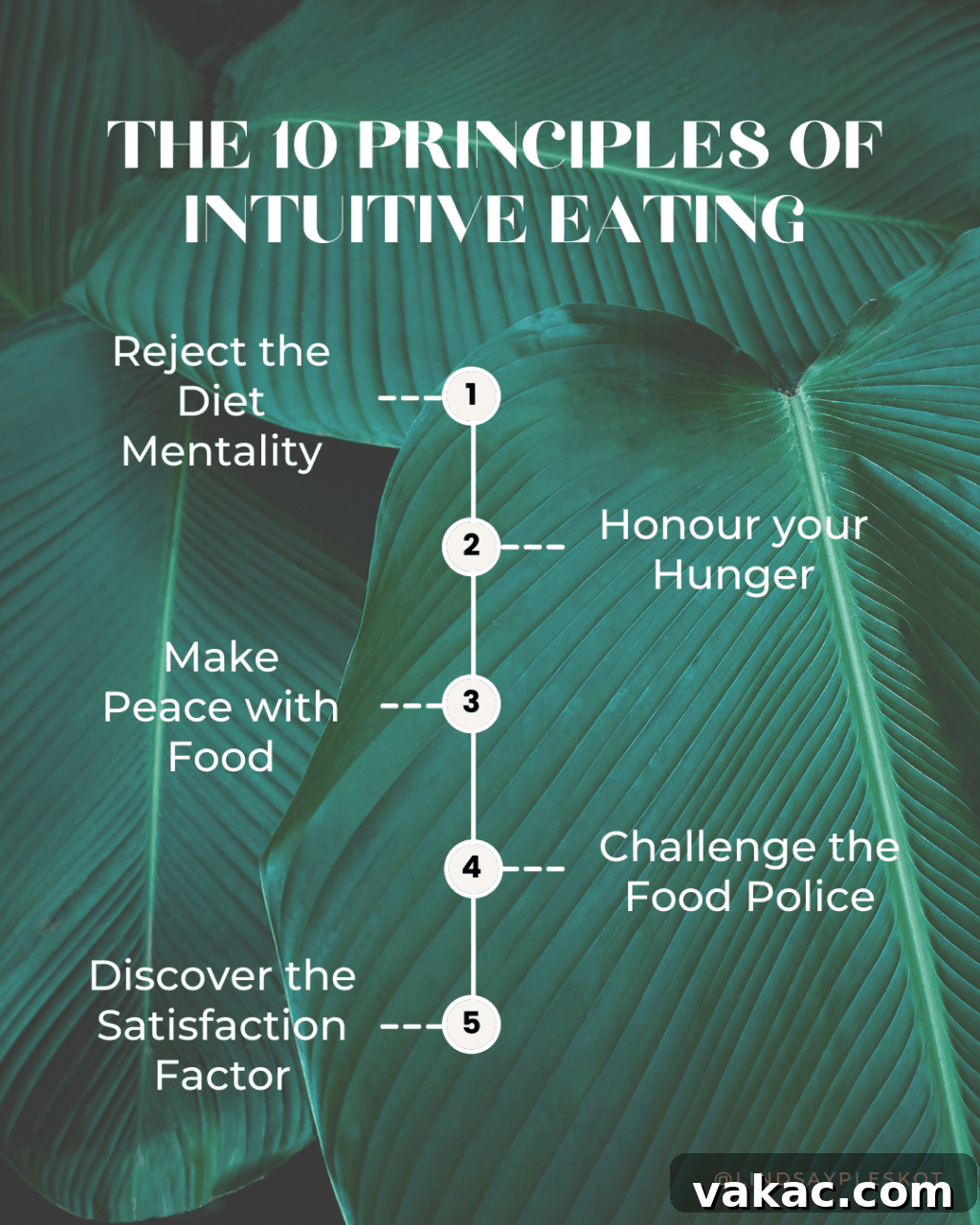
The visionary founders of intuitive eating developed 10 guiding principles to serve as a compassionate roadmap for individuals seeking to embrace this liberating framework. It is crucial to understand that these are indeed *principles*, not rigid diet rules. Unlike prescriptive diets, these principles are not meant to be followed with strict adherence or in a linear fashion. They offer flexibility, recognizing that everyone’s journey is unique. Depending on where you are in your personal relationship with food and your body, certain principles may resonate more deeply or be more immediately applicable than others. You have full permission to begin wherever feels most accessible and relevant to you, without the pressure of following a particular order.
Principle 1: Reject the Diet Mentality
If you’ve ever found yourself yearning to lose weight or embarked on a diet, you are in vast company. The majority of our clients, upon their first consultation, express this very desire, often articulating their hopes for improved health, permanent weight loss, or both. This aspiration is entirely understandable, given that we are immersed in a pervasive diet culture that equates thinness with ultimate health and moral virtue, consistently promoting weight loss as the definitive means to achieve higher social status and personal fulfillment. (For a more in-depth understanding of diet culture, you can explore it here.) It’s no wonder that challenging this deeply ingrained mindset feels like an uphill battle, especially when considering that the weight loss and dieting industry is a staggering $72 billion enterprise, relentlessly marketing its solutions!
However, let’s critically unpack the promises and realities of dieting further:
The Illusion of Permanent Weight Loss through Dieting:
Overwhelming research unequivocally demonstrates that dieting is, ironically, the single largest predictor of future weight gain in the long term. Studies consistently reveal that a staggering 95% of individuals who diet (regardless of whether they maintained the diet or not) regain the lost weight within a mere two to five years. Adding to this unsettling truth, up to two-thirds of these individuals end up regaining even more weight than they initially lost. We often refer to the weight loss industry as one of the most insidious “gaslighters” out there, as it’s the only industry that can sell you a flawed product, witness its failure, and then skillfully make you feel personally responsible and at fault for its ineffectiveness.
Dieting for Health: A Counterproductive Approach:
Despite popular belief, a substantial body of research indicates that chronic dieting and the phenomenon of weight cycling—the constant, repetitive losing and regaining of weight—are actually some of the most significant confounding factors associated with an increased risk of various diseases and all-cause mortality. Moreover, the relentless pursuit of dieting and the subsequent weight cycling have also been directly linked to perpetuating weight stigma and fat-based discrimination. We now have irrefutable evidence that such stigma and discrimination profoundly and negatively impact individuals’ physical and psychological health and overall well-being. It is easy to become ensnared by the seductive fantasies and outright falsehoods propagated by the weight loss industry. To truly break free, it can be incredibly empowering to reflect on your own personal experiences with dieting. Ask yourself honestly: Did the diet truly deliver long-term results? Or are you primarily recalling only the temporary, fleeting weight loss? And critically, what has dieting genuinely cost you—socially, financially, and mentally?
Principle 2: Honour your Hunger
Every single one of us is born with an inherent, natural, and intuitive ability to recognize and respond to our internal hunger and fullness cues. These are fundamental biological signals designed to ensure our survival and well-being. However, years of navigating restrictive diets, adhering to rigid food rules, or constantly seeking external sources of guidance for our eating patterns can severely disrupt and disconnect us from these vital internal signals. This principle is fundamentally about reclaiming that innate wisdom. It champions the practice of eating enough, and frequently enough, to maintain stable blood sugar levels throughout the day, thereby allowing our bodies to function at their absolute best. By consistently honoring hunger, we effectively prevent the activation of the primal ‘caveman brain,’ a state we know all too well when extreme, overwhelming hunger kicks in, leading to eating behaviors that often feel distressing, chaotic, and beyond our control. If you currently feel out of touch with your hunger cues, a practical and incredibly helpful strategy is to learn how to effectively use the hunger-fullness scale. This tool can be a gentle way to reacquaint yourself with the more subtle, early signs of hunger before it becomes overwhelming, empowering you to respond to your body’s needs with kindness and consistency.
Principle 3: Make Peace with Food
Achieving genuine peace with food hinges on granting yourself unconditional permission to eat all foods. What exactly does “unconditional permission” entail? It means deliberately removing all morally charged labels from food, effectively ceasing the demonization of certain foods while unduly elevating others. This practice is crucial because the concept of restriction—whether it’s physical restriction through actively avoiding certain foods or mental restriction by labeling foods as ‘bad’ and subsequently experiencing intense guilt after consuming them—paradoxically fuels intense cravings and leads to episodes of overeating. We often illustrate this dynamic using the metaphor of a bow and arrow: the more you pull back on the bow (representing restriction), the greater the tension and force, until it inevitably shoots across to the opposite extreme of bingeing. This demonstrates that restriction is often the precursor to overconsumption.
Basic human psychology consistently shows us that people inherently desire what they perceive they cannot have. Furthermore, in clinical practice, we frequently observe how this type of all-or-nothing thinking (e.g., categorizing foods as ‘good’ vs. ‘bad,’ or ‘healthy’ vs. ‘unhealthy’) propels a phenomenon known as the ‘last supper mentality.’ In this mindset, individuals tend to overeat previously forbidden foods in a single sitting, driven by the erroneous belief that this will be their final opportunity to ever consume that food again. To counteract this destructive pattern, cultivate neutrality when discussing and thinking about food. For instance, you can describe food based on its objective qualities: how crunchy, sweet, or salty something is, or whether a particular food triggers your heartburn. Notice that these descriptions are rooted in facts and sensory experience, entirely devoid of judgment. You could also approach food with an attitude of curiosity rather than criticism; for example, observing that your last meal was quite carb-heavy, you might then consider: “What could I do at my next meal to create a more balanced and satisfying experience?” This gentle curiosity fosters learning without shame.
Principle 4: Challenge the Food Police
The “Food Police” refers to those critical, internalized voices in your head that relentlessly berate you for perceived ‘bad’ eating behaviors, such as breaking a food rule, while simultaneously praising you for being ‘good’ when you strictly adhere to a diet plan. These judgmental beliefs are often deeply programmed into your subconscious from an early age, frequently modeled for us by family members, friends, or societal messages. The essential first step towards effectively challenging and disarming these internal voices is to cultivate self-awareness. By becoming acutely aware of the specific food rules and beliefs that no longer serve your well-being or align with your values, you gain the power to consciously let them go. This awareness enables you to actively reframe these negative, critical thoughts with genuine self-compassion, replacing harsh self-judgment with understanding and kindness. It’s a process of internal liberation, gradually dismantling the authority of the Food Police and reclaiming autonomy over your eating experiences.
Principle 5: Discover the Satisfaction Factor
Unlocking true pleasure and satisfaction in your eating experiences is a profoundly effective way to connect with a comfortable, pleasant state of fullness. When our food choices are solely dictated by what we feel we *should* eat or what is *allowed* on a restrictive plan, we often find ourselves lingering with a lingering sense of deprivation. This can manifest as constantly wanting something else, or habitually scavenging the pantry for “just a little bit more” in a desperate attempt to feel truly satisfied. This persistent search for satisfaction often leads to overeating, not out of physical hunger, but from a psychological need that wasn’t met.
By consciously choosing foods that are genuinely pleasurable to you and by integrating mindfulness into the eating experience—truly tasting, smelling, and savoring each bite—we significantly reduce the likelihood of overeating or engaging in chaotic eating behaviors. When we prioritize satisfaction, our bodies and minds register that enough has been consumed, leading to a natural cessation of eating. If you’ve spent years entrenched in dieting, it’s completely normal to feel disconnected from your true food preferences and even struggle to identify what foods you genuinely enjoy. This principle compassionately guides you through the process of rediscovering your unique preferences and reclaiming the inherent joy and pleasure that food can bring, transforming eating into a nourishing and enjoyable act of self-care.
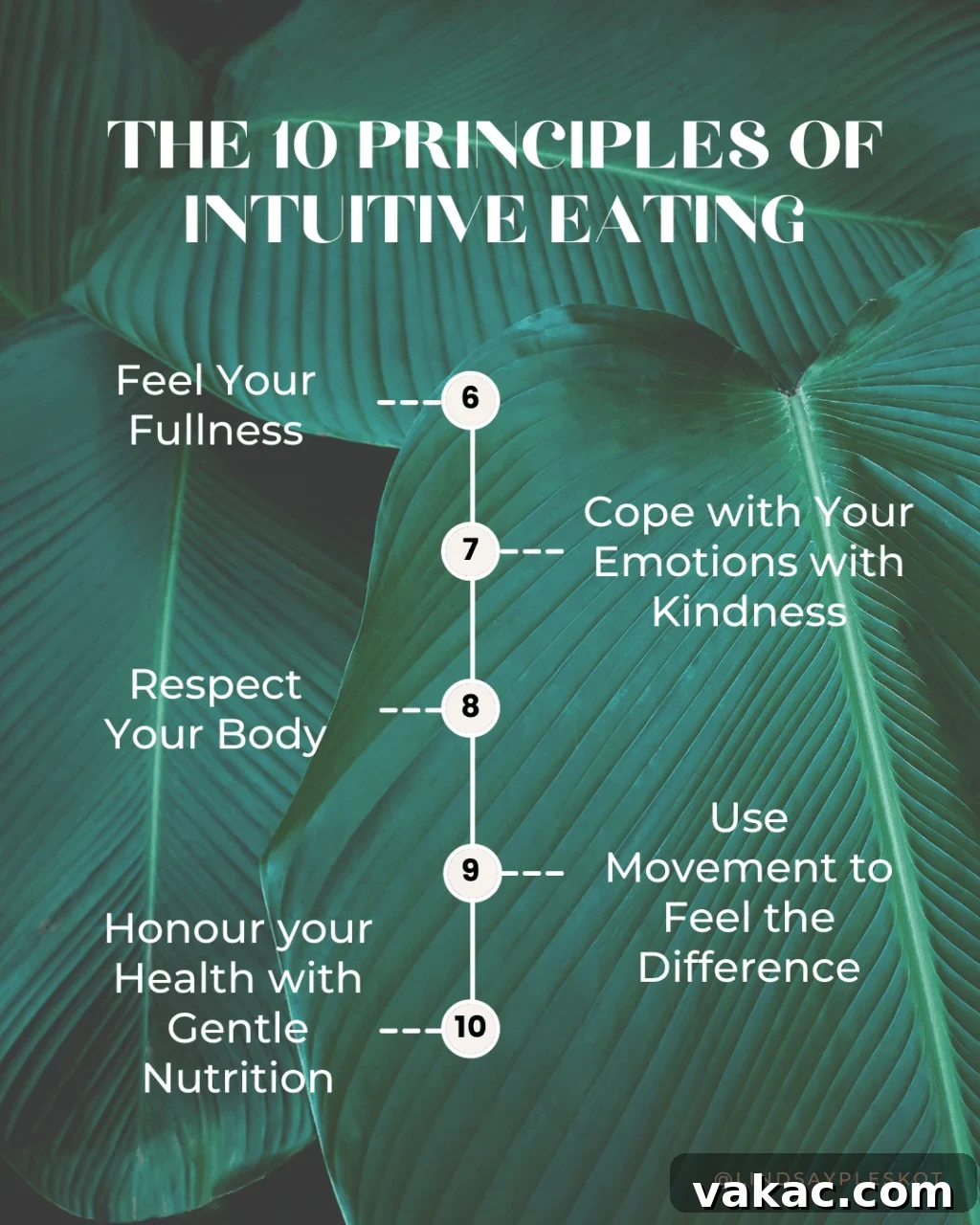
Principle 6: Feel Your Fullness
Mastering the “satisfaction factor” (Principle 5) is intrinsically linked to understanding and respecting your body’s signals of fullness. This principle guides you to identify the point where you are pleasantly full and content, experiencing comfort without succumbing to lethargy, physical discomfort, or painful overstuffed sensations. Furthermore, by consistently honoring your hunger throughout the day (Principle 2), your body begins to trust that nourishment is abundant and readily available. This consistent experience of satiety helps to dismantle the scarcity mindset that often underlies overeating, a mindset born from periods of deprivation where the body anticipates future hunger and urges you to eat more than necessary. Feeling your fullness actively encourages you to bring deep mindfulness into the eating experience. This means consciously pausing during your meal, checking in with your body, asking yourself questions like: “How does this food truly taste right now?”, “Am I still enjoying it as much as the first bite?”, and critically, “Where do I currently fall on my personal hunger-fullness scale?” By regularly practicing this internal check-in, you develop a finely tuned awareness of your body’s nuanced signals, allowing you to stop eating when comfortably satisfied, rather than uncomfortably stuffed.
Principle 7: Cope with Your Emotions with Kindness
As previously highlighted, gaining a deeper understanding of the underlying reasons behind your eating patterns is an incredibly significant step towards healing your relationship with food. We delve into the complexities of why we eat in more detail here: Why am I eating? Understanding the 3 different types of hunger. If you come to realize that you might occasionally be eating for emotional reasons—perhaps out of stress, boredom, sadness, or anxiety—it’s vital to acknowledge that this is a common and entirely normal human coping mechanism at times. However, while turning to food may offer immediate comfort or distraction in the short term, it is equally important to gently acknowledge that it may not always be the most effective or sustainable coping strategy for addressing the root cause of the emotion. Oftentimes, eating in response to emotional hunger provides a fleeting sense of solace, only to leave you feeling worse in the long run, as the underlying emotional discomfort remains unaddressed. This principle compassionately focuses on cultivating awareness of what you might truly be feeling in the moment and, subsequently, what you might genuinely need that extends beyond food. It encourages you to explore a wider repertoire of coping strategies that can more effectively address your emotional landscape, fostering genuine self-care rather than temporary emotional buffering.
Principle 8: Respect Your Body
This cornerstone principle is centered on the profound act of accepting and embracing your body exactly as it is, honoring its unique genetic blueprint. It is crucial to recognize that body diversity is a fundamental reality of human existence, despite the fact that mainstream media predominantly portrays a very narrow range of body types that constitute less than 1% of the population! The insightful Poodle Science video beautifully illustrates the concept of body diversity, posing a simple yet powerful question: we would never expect a Mastiff to physically resemble a Poodle, so why do we impose such unrealistic and often damaging expectations upon ourselves and our own unique bodies? Body positivity—a movement that encourages actively loving and celebrating one’s body—while commendable, is not a prerequisite for treating your body with inherent dignity and profound respect. We frequently encourage our clients to begin their journey with body neutrality. This powerful concept posits that you can simply exist and be inherently worthy of respect, care, and kindness without needing to hold a strong positive *or* negative opinion about your body at all. It’s about peaceful coexistence. If you are seeking additional support and resources for cultivating body acceptance and challenging societal body ideals, the documentary Behind the Before and After: Intuitive Eating and Body Image offers an excellent starting point for deeper exploration and understanding.
Principle 9: Movement – Feel the Difference
How many of us have approached exercise with an all-or-nothing mentality? I can certainly admit to falling into this trap in the past. This rigid approach often arises when our primary motivation for movement is solely tied to the pursuit of weight loss. Our relationship with exercise can then swing wildly between two extremes: on one side, we might over-exercise, using physical activity as a punitive tool to compensate for perceived ‘eating mistakes’ or to burn off calories. On the opposite side, exercise can transform into an unpleasant, dreaded chore, leaving us feeling completely unmotivated and disengaged from moving our bodies. This principle advocates for a radical shift in perspective. Instead of focusing on calories burned or body size altered, it encourages you to deeply connect with *how* movement makes you feel. It’s about finding joyful, invigorating, and sustainable ways to move your body, allowing physical activity to become an inherent source of pleasure and vitality rather than a burdensome obligation. By prioritizing the internal sensations of strength, energy, mood enhancement, and overall well-being, movement naturally becomes an integrated and cherished part of your life, sustained with effortless ease and genuine enjoyment.
Principle 10: Honour your Health with Gentle Nutrition
As a Registered Dietitian, I am deeply passionate and genuinely excited about the profound ways in which nutrition can nourish our cells, significantly boost both our physical and mental health, and play a crucial role in managing and reducing the risk of chronic diseases. However, we also understand a vital truth: truly honoring our health and cultivating a joyful, peaceful relationship with food must originate from a place of genuine self-care and respect, not from guilt, shame, or obligation. Only then can our dietary choices be truly sustainable and enjoyable in the long term. This tenth and final principle of intuitive eating is all about embracing gentle nutrition. It focuses on observing our overall eating patterns, noticing how various foods contribute to our well-being, and integrating balanced choices with a flexible mindset. Critically, it acknowledges the liberating truth that no single snack, no solitary meal, and not even one entire day of eating will ever make or break our overall health trajectory. It’s about consistent kindness and intelligent choices, not perfection or punishment.
Common Misconceptions About Intuitive Eating: Setting the Record Straight
Despite its growing recognition, intuitive eating is frequently misunderstood. Let’s address some of the most common misconceptions:
Misconception 1: Intuitive Fasting is Intuitive Eating
Absolutely not. While you might encounter books or programs marketed as “Intuitive Fasting,” implying an anti-diet philosophy, this is a misleading rebrand. Intuitive Fasting is, at its core, simply another iteration of trendy fad diets that incorporate restriction—in this case, through controlled periods of not eating. Intuitive Eating, by contrast, is fundamentally opposed to any form of restriction, advocating instead for honoring true hunger and fullness cues and making peace with all foods. Its entire framework is built on listening to internal signals, which fasting inherently overrides by imposing external rules on when and how much to eat.
Misconception 2: Intuitive Eating is “The Hunger and Fullness Diet”
This is another cunning way that diet culture attempts to co-opt and distort the principles of Intuitive Eating, turning it into yet another restrictive diet. While consciously feeling your hunger and fullness cues is indeed a crucial practice within Intuitive Eating, it is not meant to become a new set of rigid rules or an external metric to fixate upon. The goal is awareness and gentle guidance, not self-policing or restriction. When hunger and fullness become rigid guidelines, they transform into another tool for control and deprivation, missing the broader, compassionate intent of the intuitive eating framework, which encompasses all 10 principles, not just two.
Misconception 3: Intuitive Eating will Automatically Make You Lose Weight
This is one of the most persistent and misleading myths. On your personal intuitive eating journey, your body size may indeed fluctuate—it might go up, it might go down, or it might remain exactly the same. No one can predict with certainty which outcome will occur for any individual, as body weight is influenced by a complex interplay of genetics, environment, and lifestyle, independent of dieting efforts. The fundamental aim of healing your relationship with food and fully embracing intuitive eating is to allow your body to settle into its natural, genetically predetermined set point weight range. This is the weight at which your body functions optimally and feels its healthiest, free from the stress and yo-yoing caused by chronic dieting. Intuitive eating prioritizes health behaviors and psychological well-being over a specific number on the scale.
Misconception 4: Intuitive Eating Just Means You Can Eat ‘Junk Food’ All Day Long
A very common misunderstanding of Intuitive Eating is the idea that it indiscriminately glorifies the consumption of ‘junk foods’ (or ‘fun foods,’ as we prefer to call them) without any regard for health, nourishment, or how these foods actually make you feel. While it is true that many individuals experience an initial ‘honeymoon phase’ when they first embrace unconditional permission to eat, often indulging in previously forbidden foods, this is a completely normal and integral part of the process of food habituation. Habituation is the psychological process where repeated, unrestricted exposure to a food gradually diminishes its ‘special’ or ‘forbidden’ allure. Over time, once the novelty and deprivation are removed, the body naturally seeks a wider variety of foods, including nutritious options. Intuitive eating is a comprehensive practice that involves deeply healing your relationship with all foods, learning to respect and take compassionate care of yourself, and understanding how all foods, in balance and moderation, can fit into and contribute positively to your overall health and well-being. It’s about balance, satisfaction, and listening to your body’s needs, not unrestrained indulgence.
Now Over to You… Share Your Insights!
We’ve covered a great deal about Intuitive Eating, from its foundational principles to common misconceptions. What other myths or misunderstandings about Intuitive Eating have you encountered or heard in your own experiences? Are there any additional questions regarding Intuitive Eating that we might have missed or that you’d like to explore further? We invite you to share your thoughts, questions, and insights with us in the comments section below! Your contributions enrich this conversation for everyone. And if you found this post to be informative and helpful, please consider passing it along to a friend or family member who could also benefit from embracing the transformative power of intuitive eating!