

Do you often find yourself caught in a relentless cycle of guilt after enjoying certain foods? Perhaps the nagging feeling that you’ve eaten “too much” or “given in” to “bad” foods is a familiar companion. As mindful and intuitive eating dietitians, we are dedicated to guiding you away from the chains of food guilt and towards the liberating embrace of food freedom!
The Ultimate Guide to Overcoming Food Guilt and Embracing Food Freedom
For nearly a decade, I was trapped in the suffocating grip of extreme food guilt and shame. This insidious feeling didn’t just hover; it consumed my life, dictating my thoughts and actions. Every waking moment was spent meticulously planning what I “should” or “shouldn’t” eat, and the aftermath of consuming foods I unfairly labeled “bad” was always a tidal wave of guilt. My mind would race, obsessing over how I was going to “make up for it,” initiating a toxic cycle that many can relate to. This invariably led to stringent restriction, which in turn fostered intense feelings of deprivation. It was only a matter of time before this deprivation culminated in episodes of overeating or bingeing, leaving me feeling utterly out of control around food. And then, like clockwork, the crushing weight of food guilt would return, restarting the entire agonizing cycle all over again.
Paradoxically, embarking on a program so deeply rooted in food and nutrition to become a dietitian filled me with apprehension. I worried it would only intensify my existing food obsession. However, this journey unexpectedly became my salvation. It led me to where I stand today: a place of complete food freedom, utterly devoid of food guilt or shame. I am profoundly grateful to now have the privilege of serving as a mindful eating dietitian, dedicated to supporting individuals like you in finding the same liberation and peace with food.
In this comprehensive guide, I am thrilled to share five transformative steps designed to help you stop feeling guilty after eating, conquer that all-consuming food guilt, and finally reclaim your presence in life. By applying these strategies, you can begin to reconnect with the inherent joy that eating is meant to bring, fostering a truly healthy and sustainable relationship with food and your body.
Understanding Guilt: A Learned Emotion
Guilt is a deeply conditioned emotion, meaning it is something we learn to experience when we perceive ourselves to have done something wrong. In its healthy form, guilt serves as a vital internal compass, prompting us to reflect and course-correct. For instance, if we’ve unintentionally hurt someone, stolen an item, or withheld the truth, guilt can compel us to acknowledge our actions and make amends. It helps us check in with our moral code and adjust our behavior for the better.
However, because guilt is a learned response, we can also inadvertently attach it to situations where it genuinely doesn’t belong. This is particularly evident in the pervasive realm of diet culture. Diet culture has so thoroughly infiltrated our societal narratives and personal belief systems that we often fail to recognize when our thoughts and perceptions about food have been hijacked by its restrictive and judgmental doctrines. This hijacking frequently leads to an unwarranted and deeply damaging form of food guilt, which serves no positive purpose and only perpetuates a cycle of shame and self-reproach.
Ready to Transform Your Relationship with Food?
Go beyond simply what you eat. Delve into the intricate “why” behind your eating habits, explore how different foods make you feel, and uncover any patterns that influence your choices and well-being. Begin your personalized journey to genuine food freedom today!
What Exactly is Food Guilt?
Food guilt is the profound and often debilitating feeling that we’ve committed an error or transgression simply by eating—or not eating—certain foods. It manifests as shame for consuming “too much,” or for adhering to particular eating habits that we’ve been taught to deem undesirable. It’s truly astonishing how, in our society, it has become almost normalized for conversations to revolve around our bodies, our eating behaviors, or how “good” or “bad” we’ve been with our food choices. This constant scrutiny fosters an environment ripe for food guilt to thrive.
However, we are here to fundamentally change that narrative, starting right now. I want you to internalize this crucial truth:
There are no foods that are inherently “good” or “bad.” Consequently, you are absolutely not a “good” or “bad” person for the food choices you make. Your inherent morality, your worth, and your character have precisely zero to do with the types of foods you choose to eat.
Understanding this distinction is the first step towards dismantling the oppressive framework of food guilt. So, how do we actively break free from this relentless cycle of feeling guilty after eating? How do we navigate our way to a place of sustainable food freedom, where the simple act of eating becomes a source of fun, nourishment, and genuine joy once more?
5 Transformative Steps to Achieving Food Freedom
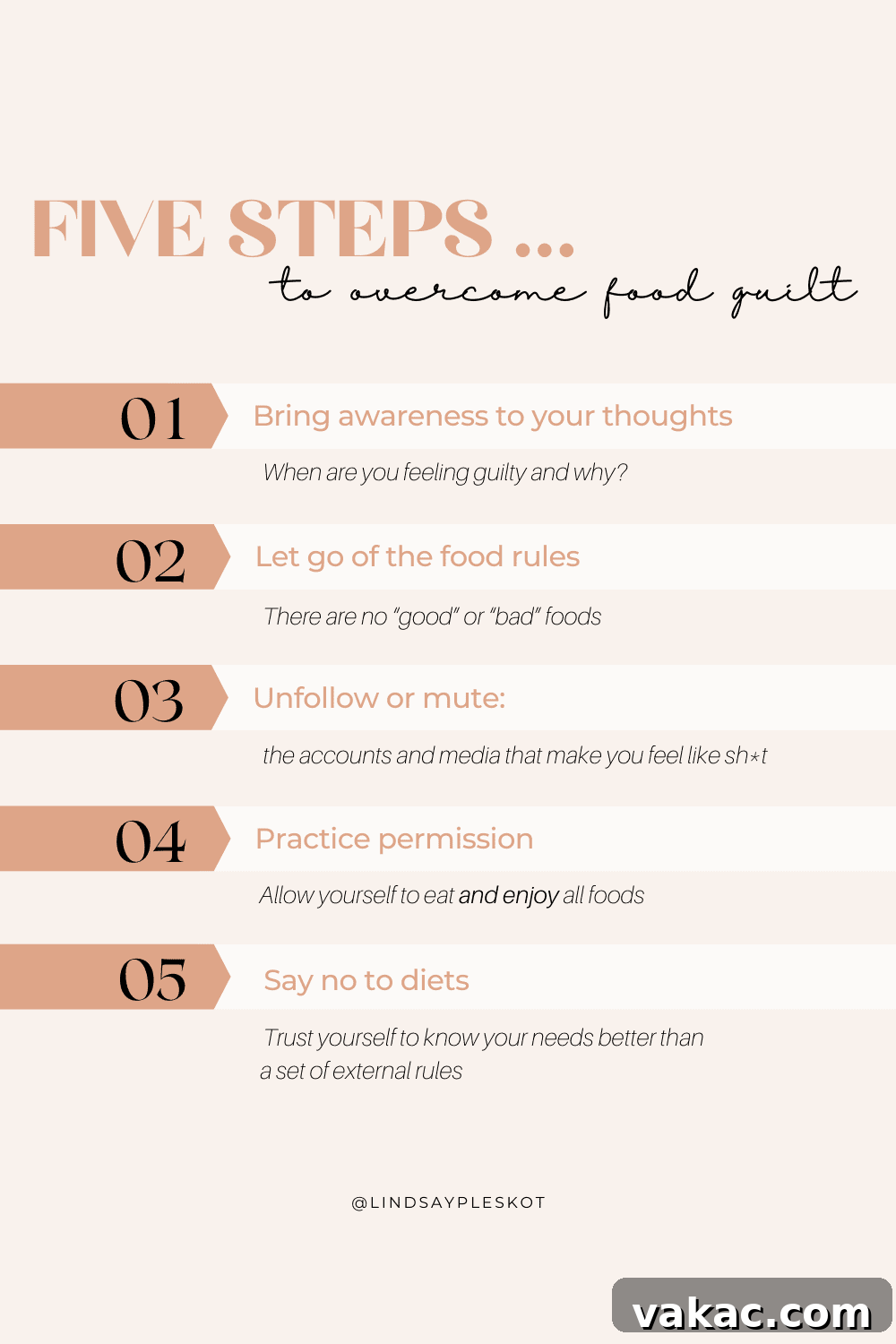
1. Cultivate Mindful Awareness: Unpacking Your Thoughts and Triggers
The foundational truth in any journey of change is that we cannot alter what we are not aware of. Therefore, the very first, critical step in overcoming food guilt is to consciously bring notice to its presence and understand its triggers. This is precisely where mindful eating emerges as an incredibly powerful and gentle tool. It invites us to observe our thoughts, feelings, and physical sensations surrounding food without judgment.
Approaching what you notice with genuine curiosity, rather than immediate judgment or self-criticism, fundamentally transforms this process. This curious stance significantly reduces the overwhelming pressure to get it “right” or to “fix” something immediately. Instead, it creates a safe space for exploration and understanding. Initially, the goal isn’t to take action, but simply to observe, to acknowledge when the guilt arises, and to gently inquire into the “why” behind it.
The very act of engaging in mindful awareness *is* action. It is a powerful internal shift. By allowing yourself the necessary time and space to explore these internal landscapes – your thoughts, your emotions, your physical responses – you empower yourself to make changes that are not only intentional and deeply meaningful but also sustainable and impactful for the long term. This isn’t about quick fixes; it’s about building lasting peace with food.
To help you get started on this journey of self-discovery, I encourage you to download this free mindful eating food journal. It’s an invaluable resource designed to guide your observations and deepen your awareness.
2. Dismantle Restrictive Food Rules: Embrace All Foods
As you diligently cultivate awareness of your thoughts and feelings surrounding food, you will inevitably begin to identify the myriad of unhelpful food rules you unknowingly hold. These rules, often ingrained by diet culture, society, or even past experiences, dictate what, when, and how much you “should” or “shouldn’t” eat. They are the silent architects of food guilt.
This may manifest in thoughts such as:
- “If I indulge in ice cream tonight, I absolutely must skip breakfast tomorrow to compensate.”
- “Eating anything after 7 PM is strictly forbidden; it’s a guaranteed way to gain weight!”
- “No carbohydrates allowed at dinner – they’re ‘bad’ for me.”
- “I must finish everything on my plate because I paid for it, even if I’m full.”
- “Only ‘clean’ foods are acceptable; anything processed is off-limits.”
- “I can’t eat dessert unless I’ve earned it with exercise.”
The list of such restrictive rules is virtually endless and highly individualized. While you continue to use your mindful eating journal, actively take note of any food rules that surface. Once identified, the crucial next step is to consciously and compassionately let go of those rules that no longer serve your well-being, that contribute to guilt, or that prevent you from experiencing true food freedom. Recognize that these rules are often arbitrary and detrimental, leading to deprivation and the very overeating they claim to prevent.
3. Curate Your Digital and Physical Environment for Positivity
It’s a powerful truth that “where attention goes, energy flows.” In our hyper-connected world, we are constantly bombarded with messages, images, and narratives from various media platforms. If your social media feeds, television programs, or even casual conversations are perpetually filled with content that makes you feel inadequate, like you’re not doing the “right things,” or that your body “should” look or be a different way, then this exposure is actively undermining your journey to food freedom and perpetuating food guilt.
This constant influx of comparison and judgment can erode self-worth and reinforce the very diet culture beliefs we are trying to escape. Therefore, a vital step is to become a mindful curator of your environment. Take proactive steps:
- **Unfollow or Mute:** Actively unfollow accounts on social media that trigger feelings of inadequacy, promote restrictive dieting, glorify extreme body ideals, or make you feel ashamed of your food choices. Don’t hesitate to mute friends or family if their content or discussions are detrimental to your mental well-being around food and body image.
- **Seek Out Positive Influences:** Intentionally shift your attention and energy towards content that empowers you. Follow dietitians who advocate for intuitive eating and body neutrality, artists who celebrate diverse body types, and voices that promote self-compassion and genuine well-being.
- **Mind Your Conversations:** Be mindful of the conversations you engage in. Gently steer away from “diet talk” or body-shaming discussions.
By consciously focusing your attention on what genuinely makes you feel good, empowered, and at peace, you will notice a significant shift. More of that positive energy and self-acceptance will naturally begin to flow into your life, reinforcing your path to freedom.
Ready to Transform Your Relationship with Food?
Go beyond simply what you eat. Delve into the intricate “why” behind your eating habits, explore how different foods make you feel, and uncover any patterns that influence your choices and well-being. Begin your personalized journey to genuine food freedom today!
4. Practice Unconditional Permission to Eat and Enjoy All Foods: Neutralizing ‘Forbidden’ Foods
This step is often the most challenging yet profoundly liberating one. Think about all those foods you currently deem “off-limits” – the very ones that consistently trigger feelings of intense food guilt. It’s time to consciously and intentionally start giving yourself unconditional permission to eat and genuinely enjoy those foods. Observe how dramatically different the experience feels when the psychological pressure of restriction is removed.
It’s basic human psychology: we inherently desire what we perceive we cannot have. This “forbidden fruit” effect means that when we tell ourselves we “shouldn’t” eat something, our minds become fixated on it, intensifying cravings and making us more likely to overeat it when we eventually “give in.” This cycle perpetuates guilt and further entrenches the idea of “good” and “bad” foods.
When you actively practice giving yourself full permission to eat these previously forbidden foods, something remarkable happens: you begin to strip away their power. The allure of the “forbidden” diminishes. If you truly know that you can have a particular food anytime you genuinely desire it, it paradoxically makes it easier to say no when you don’t actually want it, or when you’ve had enough. This practice removes the intense shame and anxiety you might typically feel when consuming it, transforming the experience from one of transgression to one of simple choice and enjoyment. Start small, perhaps with a food you mildly restrict, and eat it mindfully, observing your thoughts and sensations without judgment.
You can effectively track this progress in your food journal. Jot down the stark difference in how it feels when you eat a piece of cake while burdened with guilt versus when you eat that same piece of cake having granted yourself full, unconditional permission to enjoy it. This observational practice will solidify your understanding and reinforce the benefits of this crucial step.
5. Reject Diet Culture: A Path to Lasting Wellness and Self-Trust
This is arguably the most fundamental and impactful step towards achieving true food freedom. It requires a conscious and unwavering decision to reject diet culture in all its guises. Whether it’s macro counting, the ketogenic diet, “clean eating,” intermittent fasting, or any other rigid eating plan masquerading as a lifestyle, it’s often “same sh*t, different day” – another form of restriction and external control over your body’s innate wisdom.

It’s imperative to remember a startling fact: diets, broadly defined, have a staggering 95-98% failure rate in terms of long-term weight loss and maintenance. This isn’t a failure of *you*; it’s a failure of the diet system itself. For all the reasons we’ve discussed – having rigid rules around eating, making foods inherently “off-limits,” following external guidelines to dictate when you’re full or satisfied instead of relying on your own body’s hunger and fullness cues or what you genuinely enjoy – diets are simply not sustainable. They teach you to distrust your body and disconnect from its profound wisdom, ultimately fostering the very cycle of deprivation and guilt we aim to break.
Instead, the true path to lasting well-being and a joyful relationship with food lies in learning to understand, trust, and compassionately follow your body’s internal cues through the practice of mindful and intuitive eating. This involves returning to the fundamental principles of eating regular, balanced meals, always with ample room to genuinely enjoy your favorite foods without remorse. This holistic approach is the absolute best way to cultivate a healthy, feel-good relationship with food and your body for life.
Embrace Your Journey to Food Freedom
The journey to unlearning years, or even decades, of deeply ingrained diet culture mentality and food guilt takes time, patience, and immense self-compassion. It’s perfectly normal for this process to feel challenging at times, and you absolutely don’t have to navigate it alone. Don’t be afraid to ask for help and seek out supportive resources or professionals who specialize in mindful and intuitive eating. Remember to be exceptionally compassionate with yourself throughout this transformative process; every step, no matter how small, is a victory.
But let me assure you, from personal experience and from witnessing countless clients achieve this liberation: life is immeasurably better when you no longer feel guilty around food. Imagine the mental space you’ll reclaim, the energy you’ll free up, and the joy you’ll rediscover when food ceases to be a source of anxiety and shame. That newfound brain space can then be channeled into the things that truly fill you up, enrich your life, and bring you genuine happiness. Your food freedom awaits!